寒假高三英语检测2020.3.8
时间90分钟 总分100分
注意:1.先全部做好后再填答案。2.选择题上传到问卷星,务必看清题号,仔细校对后再提交,只能提交一次。3.语法填空和作文上传到微信小管家。
一 听力(共两节,满分30分)
第一节
听下面5段对话。每段对话后有一个小题,从题中所给的A、B、C三个选项中选出最佳选项,并标在试卷的相应位置。听完每段对话后,你都有10秒钟的时间来回答有关小题和阅读下一小题。每段对话仅读一遍。
1. What will the woman probably do?
A. Buy a book.
B. Stay at home.
C. Go to the countryside.
2. What will the woman eat?
A. Fruit and vegetables.
B. Eggs and toast.
C. Toast and fruit.
3. Whom is the woman speaking to?
A. A salesman.
B. A repairman.
C. A receptionist.
4. What does the man think of the watch?
A. He can’t tell if it is different.
B. He feels it is expensive.
C. He thinks it looks awesome.
5. What does the man mean in the end?
A. He won’t be able to watch the game.
B. He’ll go to see a doctor this weekend.
C. He won’t play in the game.
第二节
听下面5段对话或独白。每段对话或独白后有2至4个小题,从题中所给的A、B、C三个选项中选出最佳选项,并标在试卷的相应位置。听每段对话或独白前,你将有5秒钟的时间阅读各个小题;听完后,各小题将给出5秒钟的作答时间。每段对话或独白读两遍。
听第6段材料,回答第6、7题。
6. What problem are the speakers discussing?
A. A damaged box.
B. A truck accident.
C. A late delivery.
7. What will the man probably do?
A. Place another order.
B. Leave the box on the truck.
C. Check the package himself.
听第7段材料,回答第8、9题。
8. What will the man do to keep dry?
A. Put a newspaper over his head.
B. Use an umbrella.
C. Put on a raincoat.
9. Where are the speakers?
A. In California.
B. In Oregon.
C. In Arizona.
听第8段材料,回答第10至12题。
10. How many tires does the woman suggest the man replace?
A. One. B. Three. C. Two.
11. What will the man do for his car in about six months?
A. Get the left headlight checked out.
B. Get the rest of the tires replaced.
C. Get the brakes fixed.
12. How much will the man pay at last?
A. About $500.
B. About $300.
C. About $1000.
听第9段材料,回答第13至16题。
13. Where is the man moving next year?
A. To Italy.
B. To Argentina.
C. To Spain.
14. What does the man say about his French?
A. He is good at it.
B. He’s still learning it.
C. He studied it at school.
15. What kind of school did the woman go to in Thailand?
A. A local school.
B. A school for international students.
C. An American school.
16. According to the man, what is best for learning a new language?
A. Communicating with the native people.
B. Living in another country.
C. Studying it every day.
听第10段材料,回答第17至20题。
17. Which product is 10% off?
A. Men’s shoes.
B. Bathroom items.
C. Women’s socks.
18. Where can soda be found?
A. In Row Seven.
B. In Row Nine.
C. In Row Six.
19. Which food is being served in Row Eight?
A. Fruit salad.
B. Baked chicken.
C. Pasta.
20. Who will help people find what they want?
A. Workers in the red shirts.
B. The speaker.
C. Chefs.
二 阅读(共两节,满分35分)
第一节 阅读理解
A
OPENINGS AND PREVIEWS
Animals Out of Paper
Yolo!Productions and the Great Griffon present the play by Rajiv Joseph,in which an origami(折纸术)artist invites a teenage talent and his teacher into her studio. Merri Milwe directs. In previews. Opens Feb.12.(West Park Presbyterian Church,165 W.86th St.212-868-4444.)
The Audience
Helen Mirren stars in the play by Peter Morgan,about Queen Elizabeth II of the UK and her private meetings with twelve Prime Ministers in the course of sixty years. Stephen Daldry directs. Also starring Dylan Baker and Judith Ivey. Previews begin Feb.14.(Schoenfeld,236 W.45th St.212-239-6200.)
Hamilton
Lin-Manuel Miranda wrote this musical about Alexander Hamilton,in which the birth of America is presented as an immigrant story. Thomas Kail directs. In previews. Opens Feb.17.(Public,425 Lafayette St.212-967-7555.)
On the Twentieth Century
Kristin Chenoweth and Peter Gallagher star in the musical comedy by Betty Comden and Adolph Green,about a Broadway producer who tries to win a movie star's love during a cross-country train journey. Scott Ellis directs,for Roundabout Theatre Company. Previews begin Feb.12.(American Airlines Theatre,227 W.42nd St.212-719-1300.)
1. What is the play by Rajiv Joseph probably about?.
A.A teenager's studio. B. A type of art.
C.A great teacher. D.A group of animals.
2. Who is the director of The Audience?
A. Helen Mirren. B. Peter Morgan.
C. Stephen Daldry. D. Dylan Baker.
3. Which play will you go to if you are interested in American history?
A. Animals Out of Paper. B. The Audience.
C. On the Twentieth Century. D. Hamilton.
B
Before the 1830s,most newspapers were sold through annual subscriptions in America, usually $8 to $10 a year. Today $8 or $10 seems a small amount of money, but at that time these amounts were forbidding to most citizens. Accordingly, newspapers were read almost only by rich people in politics or the trades. In addition, most newspapers had little in them that would appeal to a mass audience. They were dull and visually forbidding. But the revolution that was taking place in the 1830s would change all that.
The trend, then, was toward the "penny paper"-a term referring to papers made widely available to the public. It meant any inexpensive newspaper; perhaps more importantly it meant newspapers that could be bought in single copies on the street.
This development did not take place overnight. It had been possible(but not easy)to buy single copies of newspapers before 1830,but this usually meant the reader had to go down to the printer's office to purchase a copy. Street sales were almost unknown. However, within a few years, street sales of newspapers would be commonplace in eastern cities. At first the price of single copies was seldom a penny-usually two or three cents was charged-and some of the older well-known papers charged five or six cents. But the phrase "penny paper " caught the public's fancy, and soon there would be papers that did indeed sell for only a penny.
This new trend of newspapers for "the man on the street" did not begin well. Some of the early ventures(企业)were immediate failures. Publishers already in business, people who were owners of successful papers, had little desire to change the tradition. It took a few youthful and daring businessmen to get the ball rolling.
4.Which of the following best describes newspapers in America before the 1830s?
A. Academic. B. Inexpensive.
C. Unattractive. D. Confidential.
5.What did street sales mean to newspapers?
A. They could have more readers.
B. They would disappear from cities.
C. They would be priced higher.
D. They could regain public trust.
6.What can we say about the birth of the penny paper?
A. It was a disaster for printers.
B. It was a temporary success.
C. It was a robbery of the poor.
D. It was a difficult process.
C
Growing up in Arizona's rodeo (竞技)country, I was familiar with the events that come with traveling rodeos: bull riding, dressing and mutton busting. Mutton busting is like bull riding, but instead of bulls, they use sheep. And in place of the men, it's children between six and ten years old who try to hang on for eight seconds.
It took me all of five minutes to say yes to the idea of riding a sheep. Being seven years old, my decision-making ability was pretty limited. I figured I could ride a sheep as well as the next kid. Little did I know that I was in for a world of pain and embarrassment.
My nerves were shaking the day of the rodeo. I hated being in front of crowds. I didn't like getting dirty; I didn't even like sheep, which I thought of as just dirty and smelly. Yet there I was, getting ready to ride one for eight seconds in front of hundreds of people. I wanted to run out of the field and hide in the hot car until it was over. But by the time this idea occurred to me, it was too late. I was lifted away from my mother by a rodeo trainer and placed onto a platform.
My feet went into the narrow pen (羊圈) first. I felt my shoes touch the dirty floor of the pen. Once I was balanced on the lop of the sheep, the trainer let go and told me to lean forward・ I did as he said. I could feel the animal's heart beating faster than mine. I realized that the poor sheep was even more frightened than I was.
Then the gate opened, and I quickly discovered that my hold was too weak. Within three seconds I had fallen off the sheep, and found myself face-down on the sun-baked earth. The sheep thought this was its time to take revenge (复仇),and attacked me from behind. There I lay, hat down, covered in dirt, with tears streaming down my face. I looked behind me to see my mother running to comfort me. “Stand up and show them you're okay,” she told me as she wiped the dirty tears from my face. I stood up, dirty and upset, waved my little hand, and walked out with my mother.
Sadly, I didn't win anything, not even the respect of these rodeo animals. I did find a new admiration for those little balls of wool, though.
7. Which of the following is TRUE about "mutton busting”?
A. It's a game for 6-to-10-year-old children.
B. It is a dirty and terrible game.
C. Only strong adults can ride a sheep.
D. It is intended to pick the fastest sheep.
8. The author decided to take part in the competition because
A. he thought he could do well
B. it was part of growing up
C. mother made him do so
D. he found it very interesting
9. What is Paragraph 5 mainly about?
A. Why the author lost the competition.
B. How the author failed in the sheep riding.
C. Why a mother should comfort her child.
D. How the sheep hurt the author when it attacked.
10. We learn from the article that ________________ .
A. sheep riding is as difficult as bull riding
B. the author wanted to give up before the competition
C. sheep riding is not popular because the pen is very dirty
D. the author kept trying until he succeeded in riding a sheep
第二节 阅读七选五
“Nature does not hurry, yet everything is accomplished.” — Lao Tzu
If you are in a city where everyone rushes, realize that you don’t have to be like everyone else. You can be different. You can walk instead of driving in rush hour traffic. You can be on your iPhone or Blackberry less, and disconnected sometimes. Your environment doesn’t control your life — you do. I’m not going to tell you how to give you a step-by-step guide to moving slower. 1
Do less.
Cut back on your projects, on your task list, on how much you try to do each day. Focus not on quantity but on quality. 2 Save smaller, routine tasks for later in the day, but give yourself time to focus.
Have fewer meetings.
3 And they eat into your day, forcing you to squeeze the things you really need to do into small windows, and making you rush.
4
When you do the important things with focus, without rush, there will be things that get pushed back, and that don’t get done. And you need to ask yourself: how necessary are these things? What would happen if I stopped doing them?
Practice mindfulness.
Simply learn to live in the present, rather than things so much about future or the past. When you eat, fully appreciate your food. When you are with someone, be with them fully. When you are walking, appreciate your surroundings, no matter where you are.
Try these things out. Life is better when unrushed. 5
A. But here are some things to consider and perhaps adopt, if they work for your life.
B. The world likely won’t end if you don’t pass one of the examinations.
C. Meetings are usually a “big waste of time”.
D. Start to put off or cancel the unnecessary.
E. Pick 2-3 important things — or even just one important thing — and work on those first.
F. Give yourself more time to get ready and get there.
G. Remember the quote: if nature can get everything done without rushing, so can you.
以下两大题请写纸上再上传微信小管家,字务必写的大而整齐,拍的清楚
三 语法填空 共20分
Corona viruses are a large family of viruses that cause disease in mammals and birds. Corona viruses can cause illnesses 1_______ range from the common cold to much more severe illnesses 2______ Middle East Respiratory Syndrome (MERS) and Severe Acute Respiratory Syndrome (SARS). Experts still do not have a clear picture of the severity of the new corona virus. Officials are calling the disease a "novel" or new corona virus because it has not been found before in humans. The 3_______ (new) identified virus is thought to have spread to humans from wild animals 4______ (sell)at a market in Wuhan, in central China's Hubei province. However, it 5______(spread) between people now. Chinese officials say the disease is able to spread from one person to another even before any actual signs appear. This makes 6________especially hard to contain. Signs of the disease among infected 7________(patient) have included fever, cough, shortness of breath 8_______ general breathing difficulties. In more severe cases, the virus can cause pneumonia. Some people report few or no signs, 9._______ others have gotten very sick or even died. The U.S. Centers for Disease Control and Prevention reports that signs of the virus may appear between two and 14 days after10 _______(be) near someone who is infected.
四、应用文写作 共15分
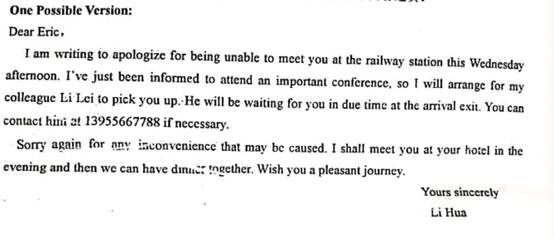
假如你是李华。你已和英国朋友Eric约定于本周三下午去高铁站接他。但你临时有重要会议不能如约前往,将委托他人接站。请你用英语给Eric写一封致歉信,主要内容包括:
1.表示歉意;
2.解释原因;
3.接站安排。
注意:
1.词数80词左右;
2.可适当增加细节,以使行文连贯。
听力:BBAAC ACABB CABCC ACBCA
阅读理解 BCD CAD AABB
七选五 AECDG
语法填空
1.Which/that 2.like 3. newly 4.sold 5.is spreading
6.it 7.patients 8.and 9.while 10. Being